
Bulgaria · Own office in Sofia
Employer of Record (EOR) in Bulgaria
Hire, pay and relocate employees in Bulgaria without opening a local company. Your Expert Support becomes the legal employer, runs euro payroll and keeps every contract compliant with Bulgarian law.
- Local team in Sofia, not a reseller
- Employees onboarded in days, no entity needed
- Payroll, taxes, permits and HR in one monthly invoice

EOR in Bulgaria
What is an Employer of Record in Bulgaria?
An Employer of Record (EOR) in Bulgaria is a local company that becomes the legal employer of your staff in Bulgaria. The EOR signs the Bulgarian employment contract, registers it with the National Revenue Agency, runs monthly payroll and pays taxes and contributions, while your company manages the employee's daily work.
Opening your own Bulgarian company (an EOOD or OOD) takes several weeks and needs a registered address, a bank account, an accountant and ongoing filings. With an EOR, you can usually have an employee under a compliant contract within days, and you can still set up your own entity later.
Why companies choose Your Expert Support in Bulgaria
Our own Sofia office
Your employees work with a local team that knows Bulgarian law and speaks their language.
Full compliance
Contracts, registrations, payroll and filings follow the Labour Code and 2026 euro rules.
One transparent invoice
Salary, taxes, contributions and our fee in a single monthly invoice.
What we do
Our Employer of Record services in Bulgaria
Everything you need to employ people in Bulgaria, handled by our team in Sofia.
Employment contracts
Bulgarian Labour Code contracts in Bulgarian and English, registered with the National Revenue Agency within three days.
Payroll in euros
Monthly payroll, payslips, income tax, social security, health insurance and all monthly declarations.
HR administration
Onboarding, leave records, sick-leave documents, employment record books, amendments and terminations.
Work permits & visas
EU Blue Card, single permits, type D visas and residence for employees and their families.
Benefits
Tax-free food vouchers, additional health insurance and other benefits, set up in a tax-efficient way.
Payroll for your entity
Already have a Bulgarian company? We run its payroll and HR administration as an outsourced provider.
How it works
Hire an employee in Bulgaria in 5 steps
From the first call to the first payslip. For EU citizens, hiring usually takes only a few days.
Consultation
Tell us the role, salary and start date. We confirm the full monthly cost in writing.
Contract
We prepare the Bulgarian contract and job description and agree them with you and the employee.
Registration
We register the contract with the National Revenue Agency before the first day.
Onboarding
Medical check referral, safety briefing and payroll set-up. The employee starts work for you.
Monthly payroll
We pay the salary, file taxes and contributions, and send you one invoice.
Employer costs
Bulgaria payroll, taxes and employer costs in 2026
Bulgaria adopted the euro on 1 January 2026 at a fixed rate of 1 EUR = 1.95583 BGN, so all salaries, taxes and contributions are now paid in euros.
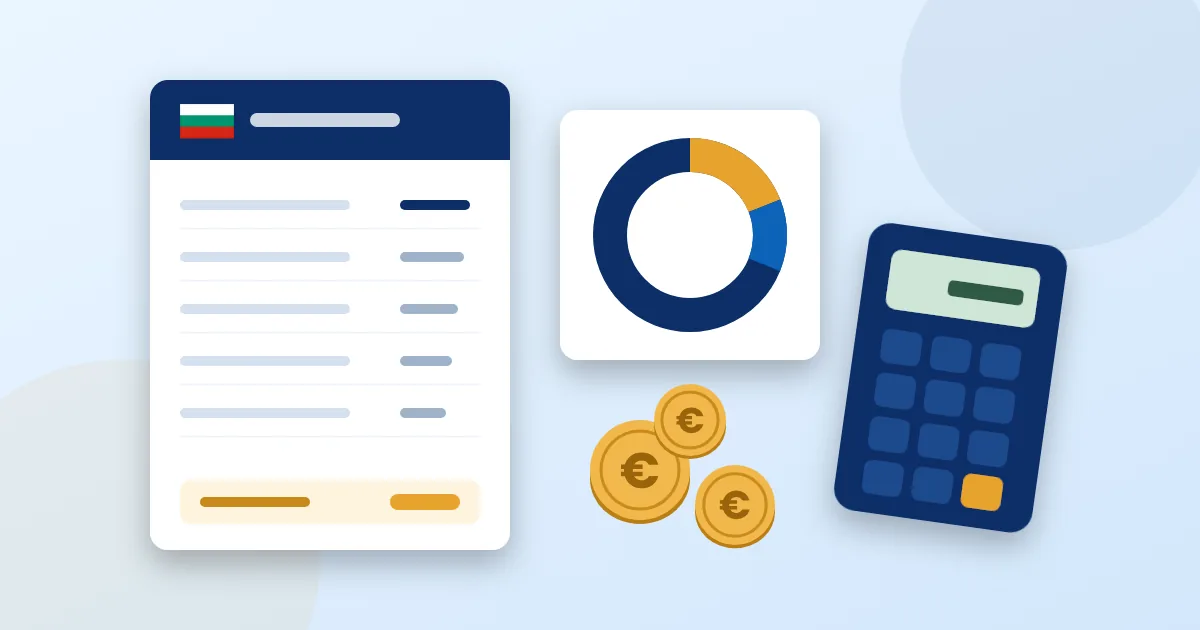
Example: employer cost for a €2,000 salary
Key payroll figures for 2026
| Item | 2026 rule |
|---|---|
| Minimum monthly wage | €620.20 (BGN 1,213) from 1 January 2026 |
| Personal income tax | 10% flat, on gross pay after employee contributions |
| Employee contributions | 13.78% of gross pay |
| Employer contributions | About 18.92%–19.62%, depending on the sector's work-accident rate |
| Maximum insurable income | €2,111.64 until 31 July 2026; €2,300 from 1 August 2026 |
| Tax-free food vouchers | Up to €102.26 per employee per month |
| Payroll frequency | Monthly |
Contribution breakdown
| Fund | Employer | Employee |
|---|---|---|
| State pension | 8.22% | 6.58% |
| Supplementary mandatory pension | 2.80% | 2.20% |
| General illness and maternity | 2.10% | 1.40% |
| Unemployment | 0.60% | 0.40% |
| Work accident and occupational disease | 0.40%–1.10% | — |
| Health insurance | 4.80% | 3.20% |
Bulgarian Labour Code
Key employment rules in Bulgaria
What every employer should know before hiring in Bulgaria. We apply these rules to every contract we manage.
Contracts must be in writing and registered with the National Revenue Agency within three days, before work starts. A probation period of up to six months can be agreed.
8 hours a day, 5 days a week. Overtime is paid at least +50% on working days, +75% on weekends and +100% on public holidays.
At least 20 working days of paid leave a year, plus around 13 public holidays. A holiday that falls on a weekend moves to the next working day.
The employer pays the first days of sick leave at 70%, then the National Social Security Institute pays. Fathers get 15 days of paternity leave.
Employees receive a length-of-service supplement of at least 0.6% of base salary for each year of service.
Standard notice for an indefinite contract, extendable to three months by contract. Dismissal is only possible on Labour Code grounds; unused leave is paid out.
Immigration
Work permits and visas in Bulgaria
EU, EEA and Swiss citizens can work in Bulgaria without a permit and only register their residence. Employees from other countries need a work and residence permit before they start. Our immigration team prepares the application and supports relocation.
EU Blue Card Up to 5 years
For highly qualified roles. Salary of at least 1.5× the national average gross salary (about €2,054 a month as of early 2026), a contract of at least 6 months and a recognised degree or relevant experience.
Single permit Up to 3 years
For other roles. Usually needs a labour market test and pay no less favourable than for Bulgarian employees, and is subject to a cap on the share of non-EU staff.
Compare
EOR or your own company in Bulgaria?
Many companies start with an EOR and open their own entity later. We support both, including legal entity setup and transferring your employees.
| Employer of Record | Your own Bulgarian entity | |
|---|---|---|
| Time to hire | Days | Weeks to set up, then hiring |
| Set-up cost | None | Registration, address, bank, accounting |
| Ongoing compliance | Handled by the EOR | Your responsibility |
| Best for | 1–20 employees, testing the market | Large, long-term teams |
Local presence
A real team in Sofia, not a reseller
Your Expert Support runs its own office in Sofia. Your employees in Bulgaria get answers from people who handle Bulgarian payroll and employment law every day, and you get one point of contact for all four of our markets.
Your Expert Support – Sofia
FAQ
Employer of Record in Bulgaria: questions
Quick answers to what clients ask us most about hiring in Bulgaria.
Can a foreign company hire employees in Bulgaria without a local entity?
Yes. A foreign company can hire employees in Bulgaria through an Employer of Record. The EOR is the legal employer in Bulgaria and handles the contract, payroll, taxes and compliance, while the foreign company manages the employee's work.
How much does it cost to employ someone in Bulgaria?
On top of gross salary, employers in Bulgaria pay social security and health insurance contributions of about 18.92%–19.62%, up to the maximum insurable income of €2,300 a month from 1 August 2026. For a €2,000 salary, the total employer cost is about €2,378 a month before the EOR fee and benefits.
What is the minimum wage in Bulgaria in 2026?
The minimum monthly wage in Bulgaria is €620.20 (BGN 1,213) from 1 January 2026. Salaries have been paid in euros since Bulgaria adopted the euro on the same date.
How long does it take to hire through an EOR in Bulgaria?
For EU citizens, hiring through an EOR in Bulgaria usually takes a few days, as the contract only needs to be signed and registered with the National Revenue Agency. For non-EU citizens, the work permit and visa process usually adds 3 to 4 months.
How much annual leave do employees get in Bulgaria?
Employees in Bulgaria are entitled to at least 20 working days of paid annual leave each year, plus around 13 public holidays.
What is the notice period in Bulgaria?
The standard notice period for an indefinite employment contract in Bulgaria is 30 days. The contract can set a longer period of up to three months.
Ready to hire in Bulgaria?
Tell us about the role and we'll send you the full monthly employer cost and hiring timeline for Bulgaria.